Remembering Roger Shiels
The Portland Civic Builder You May Never Have Heard Of
By Douglas Obletz & Carter MacNichol
He died on March 23, 2026 at 91, with no obituary and no celebration of life—exactly as he wanted it. Roger D. Shiels spent nearly five decades quietly reshaping Portland into one of America’s most admired cities, then stepped back and let others take the bow. The Portland Mall. Pioneer Courthouse Square. The Pearl District. The Portland Streetcar. MAX light rail through the Central City. If you’ve ever stood in the heart of downtown and felt like the city was actually built for you, you were standing in Roger’s legacy—you just may not have known his name. Now, as Portland wrestles with how to reclaim its downtown, the story of the civic builder almost no one has heard of turns out to be both the most important roadmap the city has—and its most pressing challenge: finding the people willing to follow it.
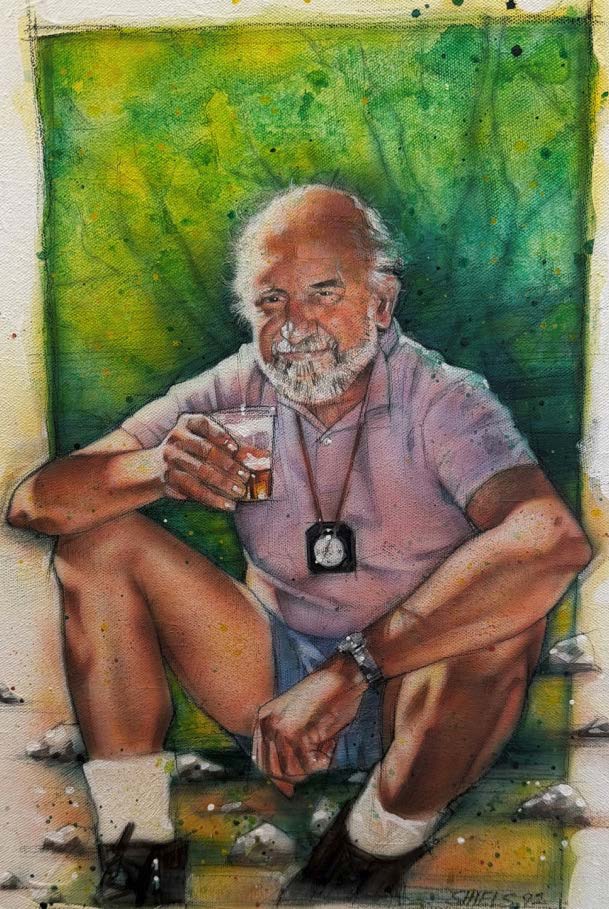
Watercolor by Jay Shiels
On March 23, 2026, Roger D. Shiels, 91, passed away quietly with family members at his side. He wanted no obituary and no public sendoff, fitting for a man who spent his life behind the scenes, largely unrecognized, building the civic stage without ever asking to stand at its center.
What’s missing in Roger’s passing is that since the early 1970s until he retired in 2014, Roger arguably had more to do with successful execution of civic development in Portland than anyone. Yet, most Portlanders have never heard his name. Though he was sad to see the current state of our central city, his contributions form an incredibly strong basis for the inevitable return of central Portland as a place of vibrant urban activity, economic prosperity and civic pride.
A native Oregonian and graduate of the U of O and later its School of Architecture, Roger had a very successful architecture business with an impressive portfolio, including scores of homes built at two of Oregon’s earliest and signature resorts—Salishan and Sun River. On a whim, Roger and his partner Bill Church returned from lunch one day and announced they were closing down their office—deciding that keeping an architectural practice running was taking the fun out of architecture. Thereafter, Roger re-invented himself as a “Project Manager.”
Initially a one-man show, Roger sought ways to improve Portland’s central core at a time when surface parking lots were its defining feature. With a new plan for downtown approved by the City in 1970, Roger was tasked by TriMet with managing the construction of the Portland Mall, a new transit spine and pedestrian-friendly space on SW Fifth and SW Sixth Avenues that was a top priority in the Central City Plan and supported by its civic leaders. This was no easy project as each street was torn up and completely replaced from building face to building face, from one end of downtown to the other. Roger knew that the ticket to success was to keep TriMet and City staff and the downtown business community well-informed, and to make sure that customer access to businesses was prioritized throughout the two-year project. When it opened in 1976, it was a key part of Portland’s reinvigorated downtown that also featured development of Tom McCall Waterfront Park and the revitalization of Old Town.
In the early 1980s, Roger was in charge of the first major renovation of Civic Stadium, a publicly funded program sold to the voters as “Your Ticket to a Decent Stadium.” This early preservation of the stadium was key to its evolution into today’s popular (and raucous) home of the Portland Timbers and Thorns soccer clubs.
A few years later, he took politically moribund plans for Pioneer Courthouse Square and turned them into the timeless gathering place in the center of Downtown.
Later in the 1980s, Roger figured out how to gain the trust and investment dollars of downtown property owners to leverage public funding to assure that the first light rail line would be a value-add to downtown. Roger pioneered the concept of the private sector taking the lead to create meaningful public-private partnerships—partnerships that built community and provided the extra funds needed to do projects at a higher level of quality with materials and finishes intended to last generations.
Then, a few years later, he helped barkeep-turned-popular-mayor, Bud Clark, turn his campaign promise of building a convention center—said to be a long shot at best—into a reality.
When the Burlington Northern railroad decided to abandon its rail yards in Northwest Portland, Roger managed efforts by the private sector to develop plans for what would become the Pearl District. This was the first time that a private development plan for a city district was presented to the City Council for approval rather than being initiated by the city’s urban planning agencies.
One of the lynchpins of the Pearl District plan was development of the Portland Streetcar.
Roger was again helping the private sector advance a plan for streetcars throughout the Central City and Lloyd District with private dollars going into both redevelopment projects and supporting the public infrastructure. When challenged on why bus lines wouldn’t work better than streetcars to meet the transportation needs of the new district and its connections to the downtown, Roger would say “no one’s going to change the route of the streetcar once we put the tracks in.” This proved prophetic: developers touted the permanence of the streetcar service as a building amenity, and renters and condo buyers embraced the idea by flocking to these urban districts—many downsizing to one car per household, or none at all.
Starting in the late 1990s, TriMet expanded light rail to the west and south, and Roger was again right in the middle of things, building on past public and private relationship success to ensure that Westside expansion through the Central City was successful. His early work on the Transit Mall was expanded with another massive rebuild of Fifth and Sixth Avenues to accommodate a combination of auto, bus and light rail service connecting the core of downtown with PSU and the South Waterfront.
Roger was renowned for his sense of humor, but also for holding project team members fully accountable for their project responsibilities. Nobody who worked on any of his projects wanted the words “No report” to show up on the minutes of a project meeting—this was tantamount to failing to do your part. He developed innovative, yet simple tools to keep projects moving forward, on budget and on schedule, while always keeping his public agency clients and key constituencies in the loop. Today, a lot of these project management tools are driven by expensive software packages, but Roger programmed his own tools using early computer coding systems (on his first-generation personal computer) before anyone even knew what being a “coder” meant.
He was a good steward of the public dollars entrusted to his administration. In one instance, Roger was incredulous about the costs for a change order being requested by a contractor. Roger called the contractor into his office and told him that he wouldn’t approve the change order. The costs were so ridiculously high, he quipped, the contractor must be buying several Ferraris with the requested payment. The contractor relented on the cost changes and showed up the next day with a scale model Ferrari as a peace gesture. Roger proudly displayed the model on his desk for years.
Roger had a knack for convincing elected officials and public agency department heads to buy into projects despite early reluctance or interagency squabbles. One public official mounted a grease gun on a wall plaque and delivered it to Roger as a project-completion memento. He knew how to get things done.
Roger wasn’t without his detractors at City Hall. In the late 70s, he didn’t see eye-to-eye with one particular mayor, and he ended up working on developing solutions for Portland’s solid waste crisis, pursuing plans to develop a landfill inside an old rock quarry. Though other solutions were adopted, he worked on this project with his patented humor and ‘get it done’ attitude.
Roger was seldom seen on the days when these incredible civic projects were dedicated.
He chose to let others take the credit and instead headed off to have a beer with his project teammates.
Ultimately, Roger’s pivot from architect to project manager earned him the architectural profession’s highest honor: election as a Fellow of the American Institute of Architects (FAIA) in 1995. Roger was recognized not simply for designing buildings, but for helping to shape a city.
More than a conventional architect, Roger became a strategist, a project leader, a trusted advisor, and a quiet city builder whose influence can still be read in almost every corner of downtown Portland. Roger religiously eschewed recognition for his work—but he was very proud of his FAIA.
This rich history of overseeing highly successful civic projects, built with public-private partnerships and good old-fashioned hard work, offers an important lesson for today’s elected officials and public agency administrators given the current backdrop of central city woes.
Downtown Portland is suffering for many reasons, including homelessness and drug use issues, and the sea change in the downtown economy brought about by the double whammy of remote work and tax structure.
Now is the time to remember the important work done by Roger and others to build a strong foundation. But it’s also the time to take action to regain the vision and acknowledge and build on the important work of those who came before us.
It wasn’t that long ago that Portland was the envy of other cities and that its rich mix of civic buildings, theaters, stores, restaurants and hotels, combined with outstanding public transit and a highly walkable downtown, made it the very center of the region and a must-see for our out-of-town guests.
To think that Portland’s future will be just fine without a strong downtown core is folly. Every great metropolitan area needs a strong core. Downtown Portland is the economic engine of Portland and the entire State of Oregon. Neglecting downtown is tantamount to saying we don’t need a “there there” to have a successful city where people want to work and live, enjoy shopping, dining and entertainment, and where visitors feel welcome. We need the businesses that only a downtown can support, and we need the jobs and prosperity that come with a dense and successful core.
And lucky for us, the makings of a successful city core are right here, ready to be built upon, improved and expanded—thanks in large part to the quiet toil of the civic builder no one knew.
But honoring that legacy doesn’t mean looking backward. It means grasping what Roger actually gave this city: not just a collection of great places, but an unambiguous model for how cities get built—through patient, unglamorous, behind-the-scenes work by people who care more about outcomes than credit. Downtown Portland has the foundation. It has the bones. It’s now up to the next generation of private and public civic builders—architects, planners, project managers, developers, community leaders, and elected officials—to do what Roger did: show up, do the hard work, and let someone else take the bow, driven by the same energy, spirit, and dedication that Roger brought every single day. The meetings will be long. The credit will go elsewhere. That was Roger’s way. The question is whether Portland can find the people willing to follow it.
Douglas Obletz and Carter MacNichol were partners with Roger Shiels in Shiels Obletz Johnsen, Inc., a development and project management firm still going strong in Portland and Seattle after over 40 years in business.